4
NEWS
Dedicated NHS Diabetes Advice helpline
0345 123 2399
IDDT Newsletters
The latest InDependent Diabetes Trust (IDDT)
Newsletters are now available on its website. The
Winter 2025 issue of the Newsletter includes articles
on SAD (seasonal affective disorder) syndrome,
recognising high blood sugars, especially at night
and how mobiles help with managing Type 1 diabetes
in children and young people.
The Winter 2025 issue of Type 2 & You includes
articles on whether children can be prescribed
anti-obesity drugs, Vitamin B12 and metformin,
whether Aloe Vera can help with Type 2 diabetes
and the best nuts and fruits for diabetes.
In addition, IDDT's free booklet, Diabetes at
Christmas, is available to order from its publications
page, along with IDDT Christmas cards, IDDT
Everyday Diary 2026, 'Food, Meds and More' recipe
book, magnetic shopping list and other items.
To view the Newsletter and to see the other
resources, CLICK HERE.
DVLA & CGM usage
The UK's Driving and Vehicle Licensing Agency (DVLA) will
now allow people with diabetes who hold Group 2 licences
to use continuous glucose monitoring to monitor their
blood glucose levels when driving.
The DVLA had previously updated its rules in 2019 to
allow people with diabetes who hold Group 1 licences for
cars and motorcycles to use continuous glucose monitors
(CGM). This change now brings the rules for those who drive
larger vehicles - such as buses, coaches and lorries - in line
with this.
The new DVLA rules say that Group 2 licence holders
with diabetes who use insulin or some other medications
that risk hypos must check their blood sugars with a CGM
no more than two hours before each journey -and then
every two hours of the journey.
Drivers should use a CGM device that is approved for
making decisions about treatment based on the CGM
readings alone. However, drivers must still pull over safely
to confirm their readings and carry a finger-prick test as a
back-up in case a CGM stops working or gives readings that
don't match the way they feel.
Drivers can also still use finger-prick tests to monitor
their glucose levels if they prefer.
To find out more, CLICK HERE.
Image from Leicester Diabetes Centre (LDC),
Loughborough University and UK logistics company,
Wincanton's health promotion programme, the 'Structured
Health Intervention for Truckers' (SHIFT).
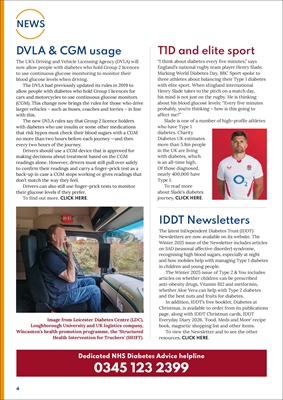
T1D and elite sport
"I think about diabetes every five minutes," says
England's national rugby team player Henry Slade.
Marking World Diabetes Day, BBC Sport spoke to
three athletes about balancing their Type 1 diabetes
with elite sport. When sEngland international
Henry Slade takes to the pitch on a match day,
his mind is not just on the rugby. He is thinking
about his blood glucose levels: "Every five minutes
probably, you're thinking - how is this going to
affect me?"
Slade is one of a number of high-profile athletes
who have Type 1
diabetes. Charity
Diabetes UK estimates
more than 5.8m people
in the UK are living
with diabetes, which
is an all-time high.
Of those diagnosed,
nearly 400,000 have
Type 1.
To read more
about Slade's diabetes
journey, CLICK HERE.