33
making carbs count FOOD
lower the risk of heart disease and
strokes.
High fibre
Chestnuts are a good source of fibre,
which has many health benefits. For
one, fibre helps add bulk to your
stools, which makes them easier to
pass. The fibre in your diet reaches
your colon largely undigested, where
it acts as a prebiotic (it becomes
source of nourishment for the
healthy bacteria in your gut that
ferment fibre).
When gut bacteria ferment fibre,
they produce various beneficial
compounds, including short-chain
fatty acids. These short-chain fatty
acids offer numerous benefits.
Studies have shown they may aid
gut health, reduce inflammation,
and improve blood sugar control.
Lastly, because fibre passes through
your body largely undigested, it
contributes to feelings of fullness
without adding calories to your
diet. This may help with weight
management.
And glucose?
Chestnuts have several intriguing
properties that may aid blood glucose
control. Despite being higher in
carbs than most nuts, chestnuts are
a good source of fibre (as mentioned)
that can help prevent glucose spikes.
In addition, research has shown that
those chestnut antioxidants, such as
gallic and ellagic acid, help manage
blood glucose and may improve
insulin sensitivity, making your cells
more responsive to insulin.
However, chestnuts are still
considered a higher carb nut. While
eating a small to moderate quantity
of chestnuts may offer these benefits,
consuming too many chestnuts
frequently may counter these health
benefits.
Other benefits
The high proportion of fibre they
contain can help you stay fuller for
longer. This is because fibre can help
slow down the time it takes for food
to empty from the stomach into the
intestines.
Inflammation is a natural process
that helps the body heal and fight
infections. In some situations,
inflammation may persist at a low
level. This is known as chronic
inflammation and is linked to
numerous chronic conditions, such
as heart disease, diabetes, and some
cancers. The antioxidants chestnuts
contain, such as vitamin C, gallic acid,
ellagic acid, and various polyphenols,
may help reduce inflammation by
neutralizing free radicals, which are
key drivers of chronic inflammation.
An easy win
Not only are chestnuts healthy, but
they are also delicious and easy to
add to your diet. They have a mildly
sweet flavour and soft yet firm
texture.
Although you can eat chestnuts
raw, they are high in tannins, which
may cause digestive issues or other
complications in people sensitive
to tannins. Jus as well then, that
they are easy to prepare. You can
roast them in the oven on a baking
sheet for 20 to 30 minutes at 400°F
(200°C). Make sure to pierce the nuts'
skin before roasting to prevent them
from exploding in the oven.
Alternatively, you can boil the
chestnuts in a pot of water. Bring
the pot to boil and then lower the
heat to allow them to simmer for
approximately 30 minutes. Again,
make sure to pierce the skin of the
chestnuts beforehand.
Once the chestnuts are cooked,
their skin is easy to remove so you
can enjoy them as a delicious snack.
They are also incredibly versatile
and you can incorporate them into
salads, stuffings, soups, and desserts,
such as tarts and pies either whole or
pureed.
www.healthline.com
Nutrition
Despite their small size,
chestnuts are packed with a
variety of nutrients. A 10-kernel
(84-gram*) serving of roasted
chestnuts provides the following:
calories: 206; protein: 3g; fat:
2g; carbs: 44g; fibre: 4.3g, or
15% of the daily value (DV) the
following percentages are all
DV -- copper: 47%; manganese:
43%; Vitamin B6: 25%; Vitamin C:
24%; thiamine: 17%; folate: 15%;
riboflavin: 11%; potassium: 11%.
*having half that serving, fivekernels, will keep the carb count
down.
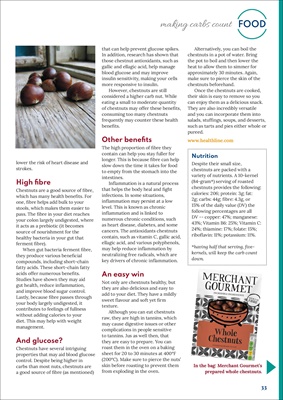
In the bag: Merchant Gourmet's
prepared whole chestnuts.